
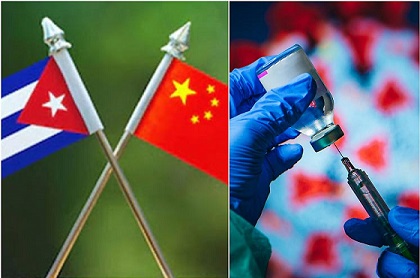
Havana (Agencies) Cuba and China presented to the National Intellectual Property Office of the Asian country the first patent for the Pan-Corona vaccine that is expected to be effective against different strains of the SARS-CoV-2 coronavirus.
According to information from the president of the BioCubaFarma group, Eduardo Martínez, said step is the result of bilateral collaboration in the biotechnological sector, specifically between the Center for Genetic Engineering and Biotechnology (CIGB), and an open facility in the city of Yongzhou, province from Hunan.
Martínez stressed that these joint investigations have the purpose of achieving effective vaccines against coronaviruses and would not only have value in the current pandemic, but could also be effective against the appearance of new pathogens belonging to this family of viruses.
During an interview with the Chinese news agency, Xinhua, the director of biomedical research of the CIGB, Gerardo Guillén, explained that the project arose at the request of the Chinese side and has the approval of the Cuban Ministry of Science and Technology.
The vaccine is based on a combination of virus parts that are conserved and not so exposed to variation to generate antibodies, with those directed at cellular responses.
Pan-Corona is a recombinant-type antigen, which is the vaccine development platform in which the CIGB has the most experience, with successful antecedents such as that of hepatitis B, in addition to two of the Cuban vaccines against Covid-19, one of these Abdala.
«It is a strategy that could protect against epidemiological emergencies of new strains of the coronavirus that may exist in the future,» he said.
In 2021, the assembly of the Yongzhou joint biotechnological innovation center was completed, with equipment and laboratories designed by specialists from the Caribbean island, projects and technologies obtained by Cuban scientific personnel will be developed there.
All the predictions and scientific rationality point to the fact that unfortunately we will have to suffer new epidemics as a logical result of the increase in the world population, animal production and the movement of people, explained Guillén.
The initiative focuses on coronaviruses not only due to the global crisis caused by SARS-CoV-2, but also taking into account that this family of viruses is one of the most likely to jump from animals to humans with antecedents such as MERS. in the Middle East or SARS-CoV-1.