By MSc. María Inés Álvarez Garay (*)
In this glorious January, full of victories, once again the authentic and worthy Cubans pay homage to a Martí who is reborn every 28 among the torches raised to the top by the hands of those who, 168 years after his birth, follow his immortal steps and his brilliant ideas, values and principles.
And there he is, present even in the most remote places of this planet, and we Cuban collaborators evoking him, because now his ideals, dreams and alerts are more current than ever.
Through his daily works and actions, the Cuban National Hero, José Martí, demonstrated the great value that he attributed to solidarity between human beings, without differences of race, creed, age or sex.
From an early age, he showed that he belonged to men who felt the pain of those who suffered abuse or were victims of exploitation due to existing racial discrimination as their own.
An eloquent example of this is one of his «Simple Verses», in which he narrated what he had experienced when, while still a child, he appreciated a slave hanging from a tree.
In a part of this poem he stated: A child saw it; he trembled Of passion for what they moan And at the foot of the dead, he swore Wash the crime with his life! Likewise, in his text «The Political Prison in Cuba», he clearly exposed his concept of solidarity between human beings by stating:
“If truly acute pains can be tempered by some enjoyment, they can only be tempered by the joy of silencing the cry of pain of others. And if something exacerbates them and makes them terrible, it is surely the conviction of our impotence to calm the pain of others ”.
And he also added in a forceful way: «I usually forget my evil when I heal the evil of others.»
As a man of great sensitivity, in the course of his brief but fruitful existence, Martí stated on several occasions the criteria he had regarding solidarity, and in that sense, through various ways he tried to influence those around him .
The life was unjusted and learned the fate that that May 19th, 1895 put him facing the Sun in Dos Ríos. Only today can we understand what his mission really was: to become the burning fire, the inextinguishable flame that will forever illuminate his people.
The Cuban Apostle resurrected in the leader of the Centennial Generation, our eternal Fidel Castro, who pointed out that Martí was the mastermind of the deed of July 26th, 1953, and resumed his ideal with which he championed the last stage of those struggles for «The second independence» of imperialism, an unfinished historical task indicated in the 19th century by the Antillean National Hero for the peoples of Our America.
On January 29th, 2003, on the occasion of the 150th anniversary of Martí’s birth, celebrated in Havana at the International Conference “For the Balance of the World,” Fidel assured: “Beyond Cuba, what did the world receive from him? An exceptional example of a creator and humanist worthy of being remembered throughout the centuries ”.
“By whom and why? For the same people who fight today and those who will fight tomorrow for the same dreams and hopes of saving the world, and because it was by chance that today humanity perceives it and becomes aware of the risks that he foresaw and warned with his deep vision and his great talent ”.
Today Martí impetuously travels through the paths of history that embraced him in eternity, to continue beating with the same independence courage and give the undefeated Cuban Revolution beats of hope.
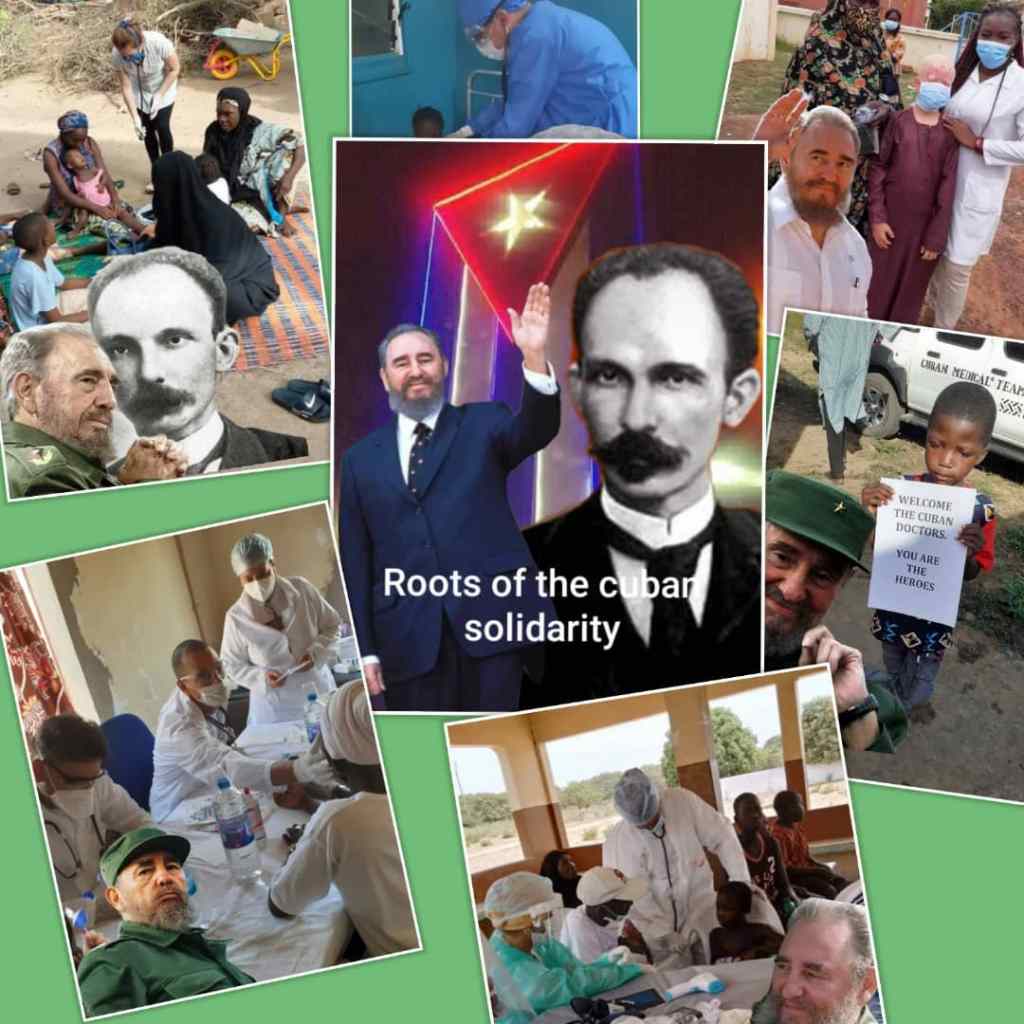
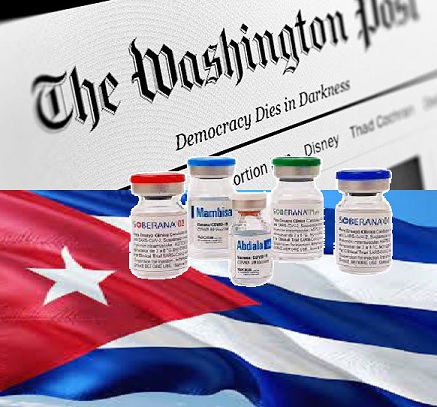
That phrase of the Apostle that «Homeland is Humanity», raised by Cubans, has saved the lives of millions of people in more than 160 nations of the world over six decades, during which health professionals from the largest of the Antilles have fought Ebola in Africa, and cholera in various regions, they have responded to the call of peoples and governments affected by floods, earthquakes and other natural disasters, and are currently facing Covid 19 on all continents.
All that beautiful history sums up what our people have upheld for the past 60 years: the principle of sharing what we have and not what is left over. This has been achieved by educating our compatriots under the principle – raised by our Commander in Chief – that solidarity is nothing more than the payment of our debt to humanity, something that is ratified day by day today to the shame of those who They attack us.
To be supportive is to be generous, generous, detached; reciprocate attitudes and actions that in the depths of each one enhance the spirit and the passage through the life of any person.
Through our blood runs the altruistic, human and solidarity inheritance of our immortal Martí and Fidel, roots of Cuban solidarity.
We have shown the world that in times of crisis, of pandemic,f ears and mistrust, Cuba continues to offer its hand of solidarity, because that is in the essence of its society, its conscience and its principles.
“Good things must be done without calling the universe to see you happen. It is good because yes; and because in there it feels like a pleasure when a good thing has been done, or something useful has been said to others. That’s better than being a prince: being useful. » Jose Marti
(*) Professor and collaborator of the Cuban Medical Brigade in The Gambia





 "An Island on a Continent"