By: María Inés Álvarez Garay (*)
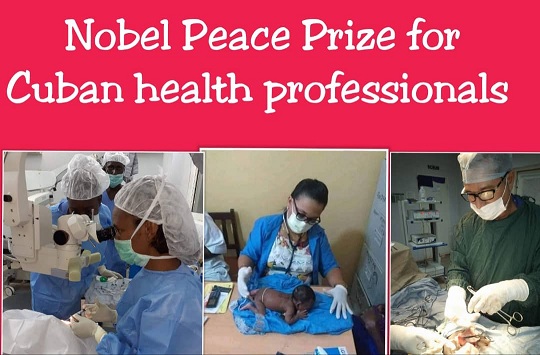
Countless voices are raised on both ends of the planet. Intellectuals, artists, political personalities, social leaders, heads of State and Government, ministers, senior officials of international organizations, Nobel Peace Prize winners and many other figures from the contemporary world, united by a single objective: They ask for a Nobel Peace Prize for Cuban Doctors, due to their high academic, scientific and professional merits in defense of humanity.
The people of Cuba throughout its history have had manifestations of solidarity with numerous nations of the world demonstrated since the beginning of the revolutionary triumph, legacies of the Latin Americanist thought of José Martí, Ernesto Che Guevara, and Fidel Castro Ruz, who gave continuity to these ideas that have been the expression of the internationalist principle of the Greater Antilles.
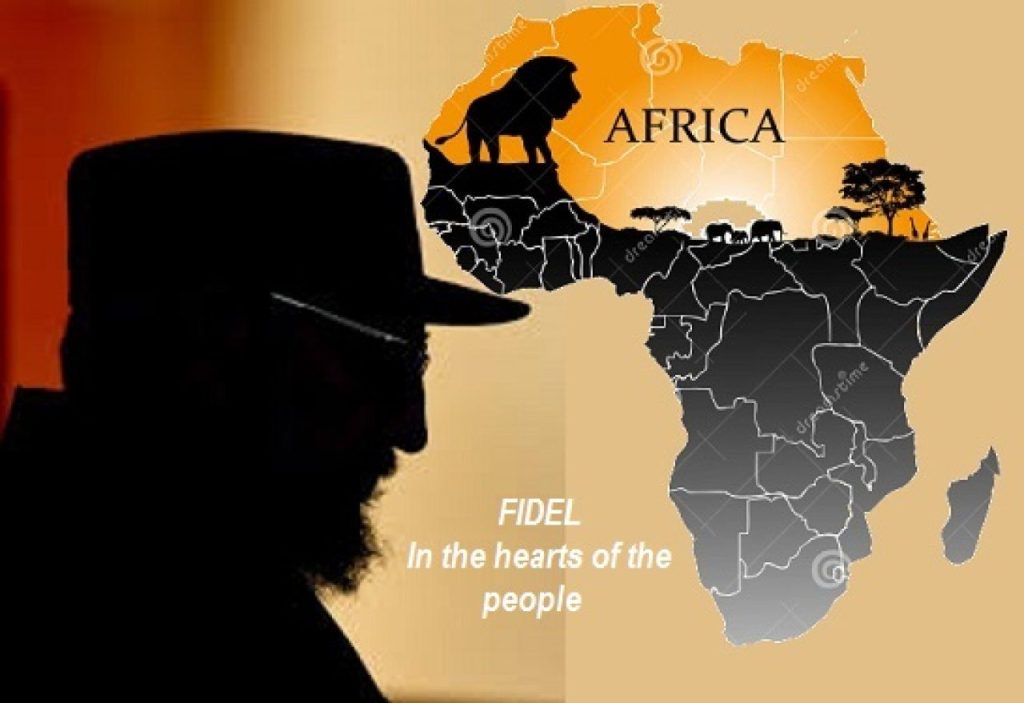
Fidel Castro sowed the seeds of Cuban medical collaboration in many countries of the world. From his creative and altruistic ingenuity many humanitarian projects were born.
In 1960, a medical brigade arrived in Valdivia in Chile to help after the earthquake that shook that Latin American country. Cuba didn’t have many doctors at the time, but it still sent a contingent of doctors and eight tons of aid. This would be the first internationalist experience.
This mission of the Cuban Revolution continued in 1963, in Algeria: 50 doctors went to support the few doctors who remained in the African country after the departure of the French.
“I am sure that there will be no shortage of volunteers (…) Today we can send only 50, but in 8 or 10 years, who knows how many, and we will be helping our brothers (…) because the Revolution has the right to reap the fruits that it has sown, «said Fidel then.
In that year the white coats began to flood remote places, to reach areas devastated by natural disasters very quickly, to heal the body and soul of many people.
And then the experiences of the towns and regions began to be told in the skin of those doctors who arrived where a doctor had never been seen, to share the pains of others as their own, to heal without noticing the poverty of their pockets.
Thousands of Chernobyl children have received free treatment at the Tarará hospital in Cuba, based on a program launched shortly after the 1986 nuclear disaster.
Free medical assistance to the poorest countries in Africa and Latin America, involved in the postcolonial transition, has continued for decades, both to health systems and in response to many tragedies and emergencies, with the stated objective of “paying off the debt with humanity ”.
The Latin American School of Medicine (ELAM), another Fidel’s idea, was born in Havana at the end of the 90s, to graduate young people in different specialties. So far tens of thousands of the three continents (including some Americans), practice their profession of healing and saving lives in their countries of origin.
In 1998, 100 doctors and nurses were sent to help in Haiti, Guatemala and Honduras, countries hit by Hurricanes Mitch and George.
That same year the Comprehensive Health Program (PIS) was launched, which consists of sending Medical Brigades to remote places, difficult to access, where there was no presence of national doctors.
Only in the first ten years of collaboration in the PIS in 42 countries, more than 457 million medical consultations were carried out, of which 174 million 732 thousand 736 patients were assisted, 954 919 deliveries performed, 2 million 832 thousand 973 surgeries and more than 2 million lives saved.
In the course of the new millennium, Cuba has become richer in health personnel (the figures speak of 76 thousand doctors, 15 thousand dentists and 89 thousand nurses)
The impulse and development of the Bolivarian Revolution in Venezuela, became an external factor that led to the appearance of the Special Programs modality, this was Barrio Adentro on April 16th, 2003.
The so-called “Miracle Mission” offered eye care, in many countries, to four million people since 2004. On July 22nd, 2005 it was extended to 15 Caribbean countries and on September 15th of the same year to 12 Latin American countries.
Another important event was the creation of the international contingent of doctors specialized in disaster situations and serious epidemics «Henry Reeve» on August 25th, 2005 at the initiative of Fidel Castro Ruz.
This contingent was created as a result of another natural disaster; Hurricane Katrina, which affected the United States territories of Louisiana, Mississippi and Alabama, and constituted a new approach to Disaster Medicine, although since 1960 Cuba has already provided this assistance in the event of natural disasters through Emerging Brigades.
In October 2005, 700 members of the Guatemalan Brigade treated the victims of snowstorm Stan, worse than Mitch.
After the earthquake in Kashmir, Pakistan, with a death toll of about 100,000, more than 2,500 doctors and nurses from Cuba climbed the mountains in that area, and in the snow they erected 30 field hospitals, to help almost two million persons. They stayed there for eight months.
In 2006, they installed 20 field hospitals in a large area of Bolivia, destroyed by floods.
In Indonesia, in late May 2006, a catastrophic earthquake struck the island of Java; six days later, the brigade was already providing support at the disaster site. In a few months, 100 communities were visited, almost 100,000 people and 2,000 surgical operations were carried out in field hospitals.
In 2010, Haiti was wiped out by an earthquake, 200,000 dead, and then cholera. The Cuban doctors already present were joined by others from the “Henry Reeve” Brigade. They worked in extreme conditions to contain cholera and they were successful. After 20 years, 600 Cubans still work on the neighboring island; to his credit, almost 600 thousand operations, and another 72 thousand eye surgeries..
In 2013, the successful More Doctors Program began in Brazil, which was boycotted shortly after by the folly of President-elect Jair Bolsonaro.
At the request of the World Health Organization (WHO) and after specific training in Havana, 256 health professionals went to combat the Ebola outbreak in West Africa, specifically in Sierra Leone, Liberia and Guinea.
At the beginning of the silent spring of 2020, Cuba once again makes its internationalist principles felt and today it has around 46 brigades participating in the global campaign against the Covid-19 pandemic, in addition to the rest of the brigades that were already exercising their humanitarian services in almost all along the world.
It is only the latest act of a Cuban internationalism in health exercised for 60 years in Latin America, Africa and Asia, which currently has more than 30 thousand workers (doctors, nurses, technicians) in 67 countries.
There are plenty of reasons to award the Nobel Peace Prize to the Pacific Army in white coats of the Caribbean island. Its members have saved millions of lives in parts of Africa, Latin America, the Caribbean and for the first time in Western Europe.
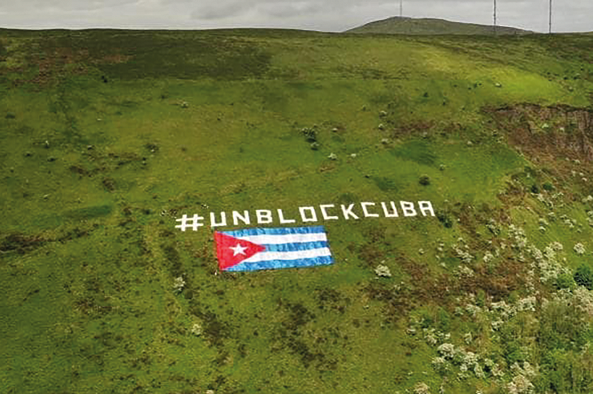
This great humanitarian work cannot be hidden, manipulated, or misrepresented, because despite the infamous blockade imposed by the United States, which has lasted almost 60 years, Cuba in solidarity continues to send its invincible peacekeepers to all corners of the world in battle for defeating Covid-19, and providing health, one of the most sacred human rights.
(*) Collaborator and professor of the Cuban Medical Brigade in Gambia




 "An Island on a Continent"